One app profile, two app stores
Store listings get rebuilt by hand for every device class, locale and store. Here is the architecture behind AppListingLab — a render pipeline with deadlines, direct store publishing, and an MCP server so agents can drive it.
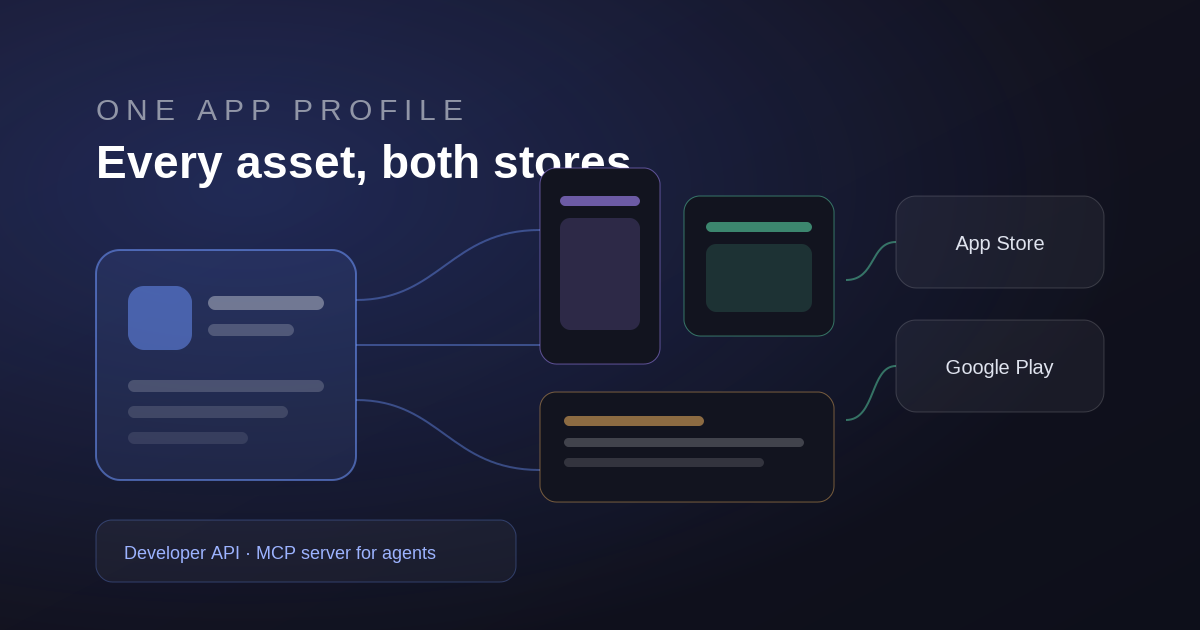
Shipping a mobile app means producing the same story at a dozen sizes. Screenshots for each device class Apple and Google require, a title and subtitle inside strict character limits, a description, keywords, an icon, and all of it again per locale. Change the positioning and most of it is stale.
AppListingLab exists because we kept doing that by hand for our own apps. The architectural bet is simple: define the app once, and derive every asset from that definition.
The app profile is the shared context
Screenshots, store copy, icons and localizations are not independent documents that happen to describe the same product. They are projections of one profile — what the app is, who it is for, the tone, the key screens.
Modelling it that way has a practical consequence. When the positioning changes, the system knows which generated assets are now inconsistent, instead of leaving a human to remember that the iPad screenshots still say the old tagline.
Rendering is a backend service with limits
The naive version of a screenshot generator runs in the browser: compose in a canvas, export a PNG. It works until you need forty assets across six device classes and several locales, with pixel-exact output that Apple will accept.
Ours renders server-side through a compiled native worker, with two properties that matter more than speed:
- Bounded deadlines and memory caps per render. A render that goes wrong is killed, reported, and does not take a worker down with it.
- A compiled worker, verified in CI. The pipeline builds once, then exercises every slot in the catalogue across all six output devices. A missing compiled worker is an explicit failure, never a silent fallback to a slower path.
That second point is the kind of thing that only looks like over-engineering until a rendering regression reaches a customer's store submission.
Publishing, not exporting
Exporting a zip of correctly sized images is the easy 80%. The remaining 20% is that someone still has to upload them, in the right order, to the right locale, on two different consoles.
So the platform talks to the stores directly, through the official App Store Connect and Google Play APIs: listing revisions, locales, and verified destinations handled by the backend. Apple's 2026 listing-asset formats — iPhone Duo, Product Page Header and Search Results — are implemented behind guarded creative publishing, because a new format is exactly where you want a guard rather than optimism.
Two stores with genuinely different models (review states, revision semantics, what a "listing" even is) behind one workflow is most of the engineering in this product.
Agents are a first-class client
The newest part is the one that changed how we think about the product surface. The same Developer API the web app uses is exposed to AI agents through an MCP server, published on npm as @applistinglab/mcp.
An agent can create a project, upload real app screens, generate screenshots and ASO text, and prepare a release without ever opening a browser. That is increasingly how this work gets done — somebody asks their coding agent to get the listing ready — and a product that only exists as a web UI is simply unavailable for that.
Designing for it imposed useful discipline. An API that an agent can drive end to end is one with no hidden state in the front end, no step that only works because a human happened to click things in order, and errors that explain what to do differently.
What we would tell ourselves at the start
- Model the shared context first. Every asset type we added afterwards was cheap because the profile already existed.
- Put the deadlines in before you need them. Render workloads fail in ways that web requests do not.
- Integrate with the stores early. Their models are the real requirements document; discovering them after the generator is built means rewriting the generator.
- Treat the API as the product, and the UI as one client of it.